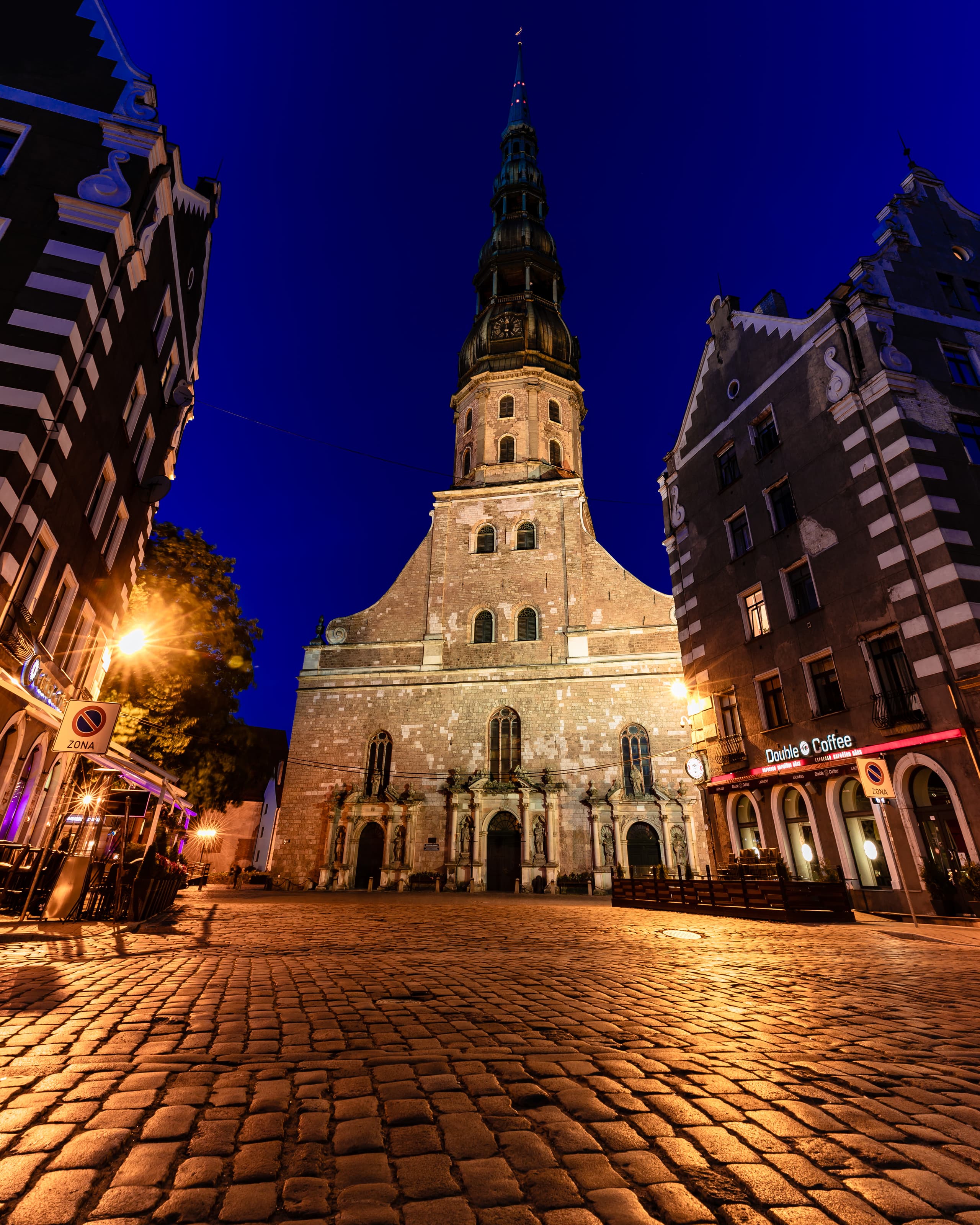
Riga's Old Town packs a UNESCO World Heritage listing, a church tower that's collapsed twice, and the largest concentration of Art Nouveau architecture anywhere in the world into a few walkable blocks.
A UNESCO old town shaped by trade
Riga's historic centre earned UNESCO World Heritage status in 1998, recognised both for its medieval old town – built on wealth from Hanseatic League trade routes – and for something less expected: more Art Nouveau buildings than any other city on earth, over 800 of them, concentrated a short walk from the Old Town along Alberta Street. Inside the Old Town itself, Town Hall Square remains the natural starting point, anchored by the House of the Blackheads – a former merchants' guildhall so thoroughly destroyed in the 20th century that its current form is a 1990s reconstruction, built after the Soviet government demolished the bombed-out ruins in 1948 despite local protests.
A spire that keeps coming back
St. Peter's Church, first documented in 1209, tells a similar story of destruction and rebuilding: its tower collapsed once in 1666, and the entire church was destroyed by artillery fire in 1941. The 123-metre spire visible today – one of the tallest structures in Riga's skyline and, in an earlier wooden Baroque version built in 1690, once the tallest wooden construction in the world – was reconstructed between 1967 and 1983, and a lift now takes visitors to a viewing gallery at 72 metres for one of the best views over the Old Town's rooftops.
Booking
The guided walking tour covers Town Hall Square, the House of the Blackheads and St. Peter's Church in about 2 hours, available in English, French, German and Spanish. Want to go inside the House of the Blackheads afterward? A separate entrance ticket covers its restored halls and medieval cellars. Prefer the water to the streets? A historic canal boat tour loops around the Old Town's former moat instead.
Good to know
Frequently asked questions
Riga's UNESCO-listed Old Town (Vecrīga) with a live guide, taking in Town Hall Square, the House of the Blackheads, and St. Peter's Church, along with the history behind them.
Image: Shawn M. Kent via Wikimedia Commons (CC BY-SA 4.0)