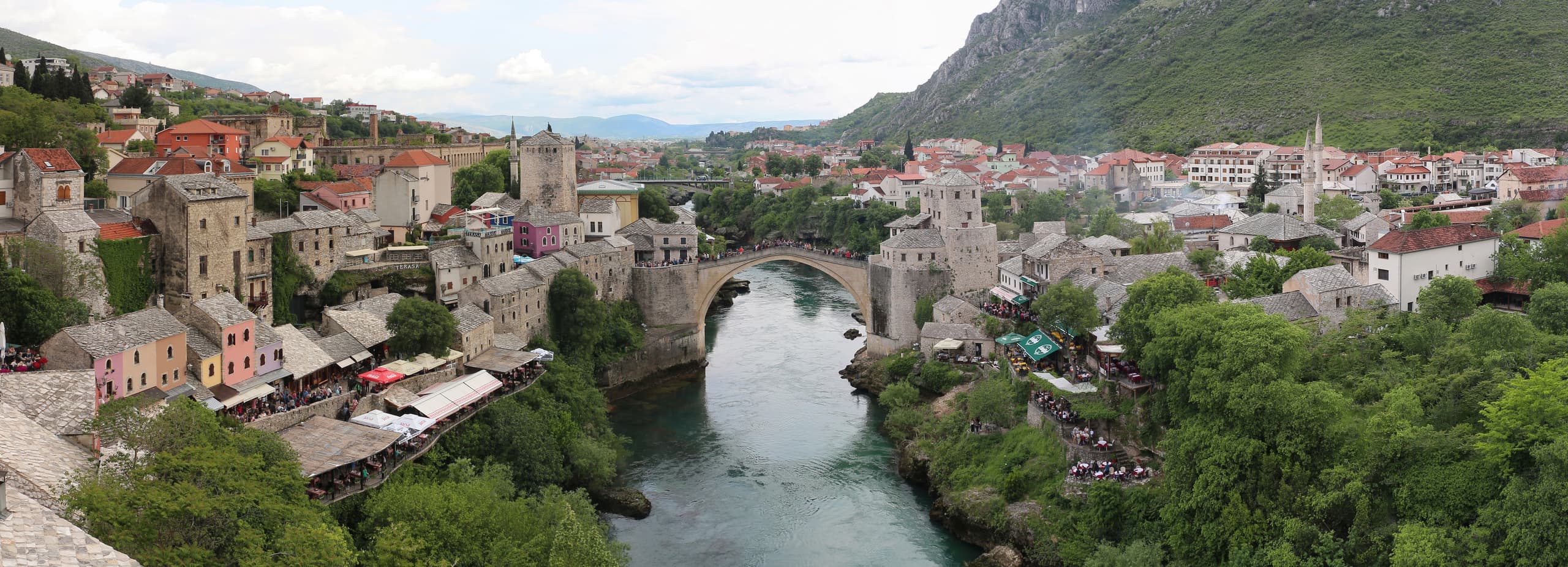
Stari Most, Mostar's Old Bridge, is a single stone arch over the Neretva that Croatian forces shelled into the river in November 1993 – and that the city, with UNESCO's help, rebuilt stone for stone by 2004.
An Ottoman bridge built to last
Suleiman the Magnificent commissioned the bridge in 1557, and the Ottoman architect Mimar Hajrudin – a student of the great imperial architect Mimar Sinan – finished it in 1566, replacing a wooden suspension bridge that had grown too weak for the town's traffic. Local legend holds that Hajrudin prepared his own funeral before the scaffolding came down, certain the single stone arch would collapse under its own weight. It didn't: the bridge stood for 427 years, connecting the two halves of Mostar's old town and giving the city its name (most means "bridge" in Bosnian).
Destroyed in a single day, rebuilt over six years
On 9 November 1993, during the Croat-Bosniak War, Croatian Defence Council (HVO) forces shelled Stari Most until it collapsed into the Neretva, cutting off a supply route used by Bosnian government forces. The loss was felt well past Mostar itself – a structure that had survived the fall of empires didn't survive the 1990s. A reconstruction coalition of UNESCO, the World Bank, the Aga Khan Trust for Culture and the World Monuments Fund began work in 1998, using the same tenelija limestone quarried locally and, where records allowed, the same 16th-century building methods. The rebuilt bridge reopened on 23 July 2004, and the Old Bridge area of Mostar was added to the UNESCO World Heritage List the following year.
The Old Town around it
Kujundžiluk, the old copper and silversmith bazaar, runs from the bridge's east end – a narrow cobbled street of workshops and stalls that's been trading since the Ottoman period. A short walk up leads to Koski Mehmed Paša Mosque, completed in 1618, where a small entrance fee lets you climb the minaret for a view straight down onto Stari Most and the river below. West of the bridge, Kriva Ćuprija (the Crooked Bridge) is a smaller, single-arch stone bridge built in 1558 – eight years before the real thing – as a trial run for the technique. Both banks are lined with cafés built right into the old riverside buildings, several with terraces that look straight onto the bridge.
Visiting today
The bridge itself is pedestrian, arched steeply enough that the paving is cut into ridges for grip, and it's a genuine bottleneck for foot traffic once the day's tour groups and bazaar shoppers fill the approach on both sides – early morning is the realistic window for photos without a crowd in them. Local divers from the Mostari diving club, a tradition dating to 1968, jump from the parapet into the Neretva below, usually collecting a fee from onlookers first; it takes years of training, and isn't something to attempt yourself. A guided walking tour of the Old Bridge and bazaar covers the history in more depth than a self-guided walk across, and pairs naturally with day trips to Kravica Waterfalls or the Blagaj Tekija dervish monastery, both under an hour away.
Good to know
Frequently asked questions
The current bridge dates to 1566, built by the Ottoman architect Mimar Hajrudin on the orders of Suleiman the Magnificent, replacing an older wooden suspension bridge that couldn't handle the growing traffic across the Neretva gorge.
Image: Bernard Gagnon via Wikimedia Commons (CC BY-SA 4.0)