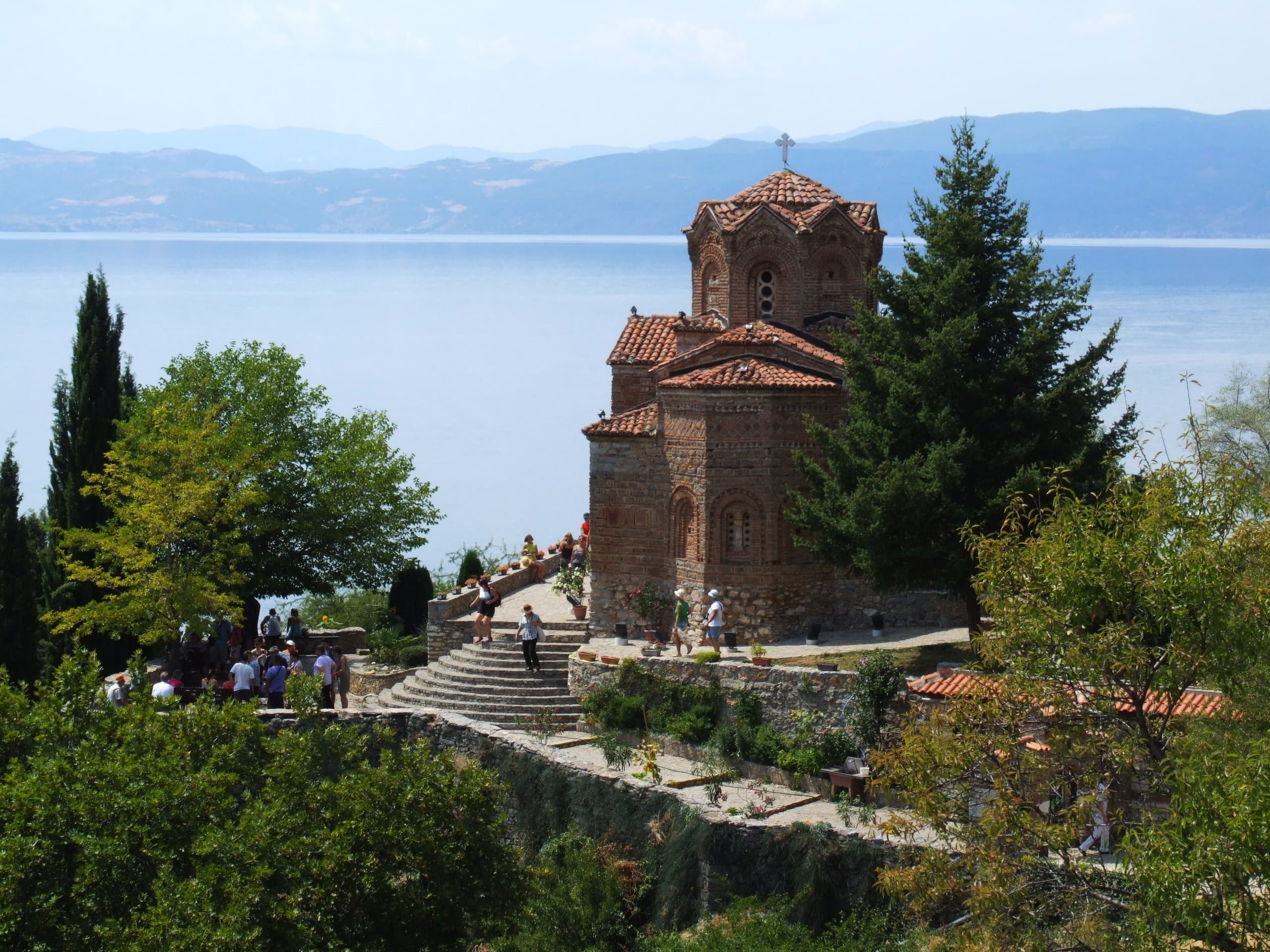
The Church of St. John at Kaneo sits on a narrow cliff jutting into Lake Ohrid, water on three sides – a single small stone building that's become one of the most photographed images associated with North Macedonia, despite nobody being entirely sure when it was first built.
A church older than its own records
No foundation document survives to date the Church of St. John at Kaneo precisely, but property records confirming its existence go back to before 1447, and the architecture itself points most archaeologists toward a 13th-century construction, with further reconstruction carried out in the 14th century, shortly before the Ottoman Empire's arrival in the region. It's dedicated to John of Patmos, traditionally credited as the author of the Book of Revelation and, in some readings, identified with John the Apostle – not, as the name sometimes suggests to first-time visitors, John the Baptist. Built as a cross inscribed within a rectangle and topped by a single dome, the church has an unusual roofline: rather than a flat or gently curved cornice, it rises into angled tympanums, a design not matched elsewhere in the central Balkans.
Frescoes older than the fixtures around them
Inside, the oldest surviving fresco fragments – in the apse beneath the dome – date to around 1290, among the older surviving religious paintings in the Ohrid region. The naos holds further fragments depicting scenes from the Passion. Much of what a visitor sees today, though, is considerably younger: the wooden iconostasis and the repainting of damaged fresco sections both date only to the 19th century, a reminder that "13th-century church" doesn't mean every visible surface inside is that old.
Reaching it
There's no road to the church – the only way in is on foot, along a lakeside path from Ohrid's Old Town that runs past Kaneo Beach before climbing the last stretch to the promontory. The walk itself, cliff on one side and open lake on the other, is as much the reason people make the trip as the building at the end of it. A small entrance fee covers the interior and frescoes; the exterior and the cliff path around it are open at any time. Most guided Old Town walking tours route past it as the final stop after Samuel's Fortress, making a natural loop back to the Old Town along the shore.
Good to know
Frequently asked questions
Its exact construction date is unknown, but property records confirm it existed before 1447, and most archaeologists date the current structure to the 13th century, with reconstruction work carried out again in the 14th century shortly before the Ottomans arrived in the region.
Image: Pudelek (Marcin Szala) via Wikimedia Commons (CC BY-SA 3.0)