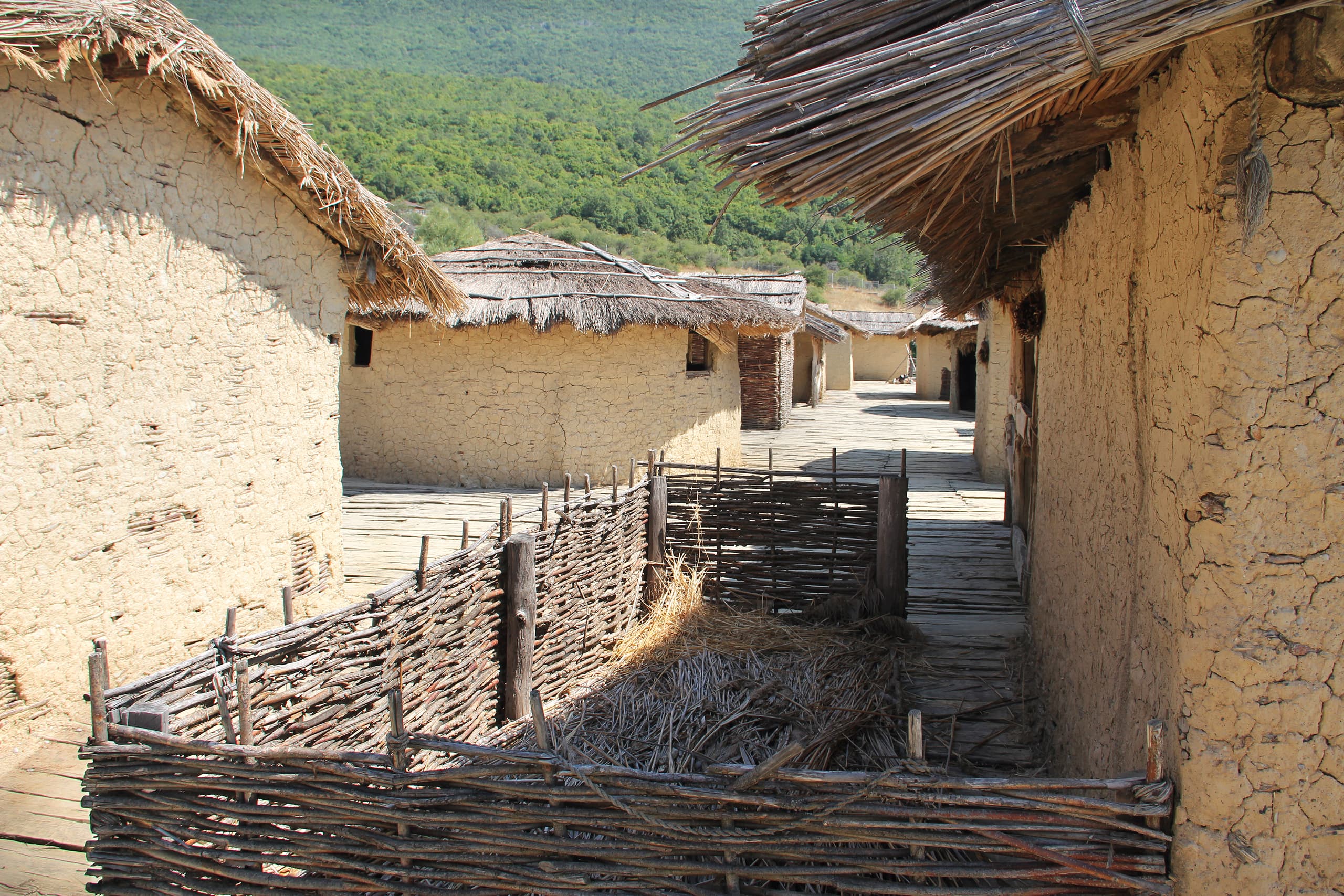
The Bay of Bones Museum is a rebuilt Bronze Age village standing on stilts directly over Lake Ohrid, reconstructed on the exact spot where archaeologists spent eight years pulling roughly 6,000 ancient wooden piles out of the lake bed.
An eight-year underwater dig
Between 1997 and 2005, underwater archaeological teams surveyed a site known as Plocha Michov Grad, near the villages of Gradishte and Peštani on Lake Ohrid's shore, working in yearly campaigns to map what turned out to be the remains of a genuine pile-dwelling (palafitte) settlement. At depths of 3 to 5 metres, they recorded roughly 6,000 wooden piles still preserved in the lake bed – the structural supports of a village that once stood on a platform above the water, dated to the Late Bronze and Early Iron Age, somewhere between 1200 and 600 BC. Alongside the piles, divers recovered large quantities of scattered animal bones and broken pottery, which gave the site its name: the Bay of Bones.
Rebuilding the village
Rather than leave the findings as an underwater curiosity accessible only to divers, archaeologists used the excavation data to reconstruct the settlement on land immediately adjacent to the original site, building a wooden platform out over the water and reconstructing the reed-and-timber huts that would have stood on it. The rebuild ran through 2007-2008, and the museum opened to the public on 8 December 2008. What visitors walk through today is a full-scale, archaeologically-grounded guess at how the village looked roughly 3,000 years ago, rather than a partial ruin – closer in spirit to an open-air experimental archaeology site than a conventional museum building.
What's at the site today
Beyond the reconstructed huts themselves, the complex includes a conserved Roman-era castrum (small fort) on the hilltop above the bay, indoor display cases holding artefacts recovered from the dig, and facilities catering to underwater tourism for visitors who want to see the surviving original piles still in place on the lake floor. It sits about 15 kilometres from Ohrid town near the village of Peštani, an easy add-on to a day that also includes one of the nearby lake beaches. It makes a natural pairing with St. Naum Monastery further down the same stretch of shore, or a Lake Ohrid boat tour departing from Ohrid's harbour, since both put the lake's unusual depth and age – the same conditions that preserved the original piles for three millennia – directly in view. A guided visit to the Bay of Bones typically includes the museum entrance and a guide who can explain the excavation findings in more depth than the on-site signage alone.
Good to know
Frequently asked questions
A reconstruction of a Late Bronze/Early Iron Age pile-dwelling settlement, built on a wooden platform directly over Lake Ohrid at the site near Peštani where the original settlement's remains were excavated.
Image: BrankaVV via Wikimedia Commons (CC BY-SA 4.0)