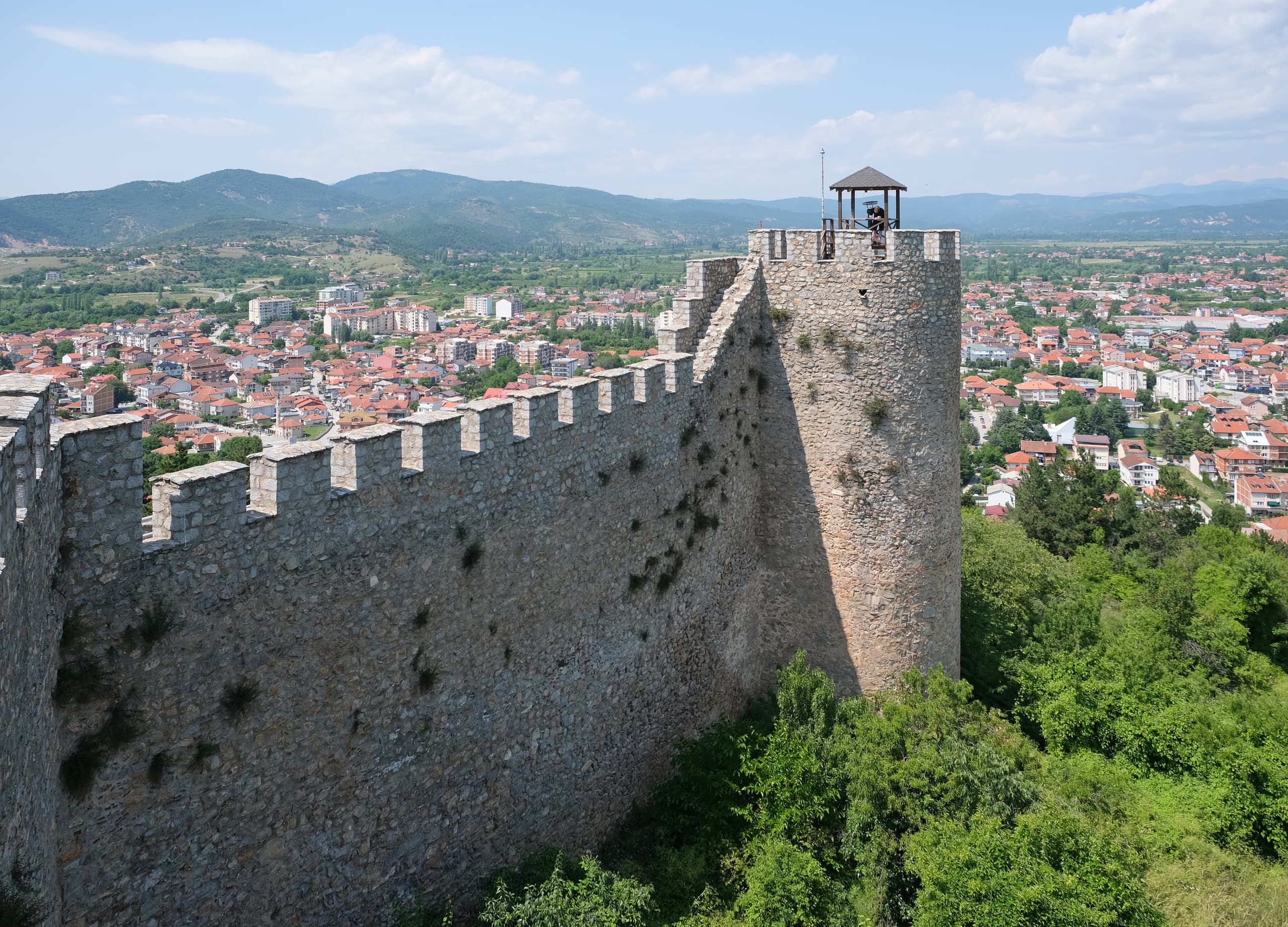
Samuel's Fortress looks down over Ohrid's Old Town from a hilltop that's been fortified in some form since at least the 4th century BC – but the walls visible today mostly date to a rebuild ordered by Tsar Samuel of Bulgaria, who made Ohrid the capital of his empire around the turn of the 11th century.
A hilltop fought over for over a thousand years
Archaeological excavation suggests the earliest fortification on this hill dates to the 4th century BC, possibly built under King Philip II of Macedon, long before any medieval citadel stood here. Its most significant chapter came under Tsar Samuel, who ruled the First Bulgarian Empire from Ohrid between 992 and 1018 during sustained resistance against Byzantine expansion – rebuilding the fortress into a proper medieval stronghold was as much a political statement as a military one, cementing Ohrid's status as an imperial capital rather than a provincial town. A major restoration in 2003 rebuilt sections of the battlements and walkways where nothing had survived, so today's fortress is a genuine mix of original medieval stonework at the base and modern reconstruction layered above it.
Walking the Old Town below
Cobbled lanes drop steeply from the fortress gates down through the Old Town's tight grid of Ottoman-era stone houses toward the lakefront, passing the Ancient Theatre – a Hellenistic-Roman amphitheatre carved into the hillside, still used for performances during the summer Ohrid festival, and the only ancient theatre of its kind preserved in North Macedonia. A short walk further reaches Plaošnik, the hilltop site of the Church of St. Clement and Panteleimon, associated with one of the two disciples (alongside St. Naum) who spread Slavic literacy and Orthodox Christianity through the region in the 9th and 10th centuries. Together, the fortress, the Old Town's street pattern and Plaošnik form the cultural half of Ohrid's dual UNESCO listing – matched by Lake Ohrid itself as the natural half, one of relatively few sites in Europe recognised for both at once.
Visiting today
The fortress walls are open to walk in full, with the best views looking straight down over the Old Town's terracotta rooftops to the lake, and on a clear day across the water to the mountains on Albania's shore. A guided walking tour of the Old Town and fortress typically covers all three sites – the fortress, the Ancient Theatre and Plaošnik – in one route, useful given the steep, unmarked lanes between them. It pairs naturally with the clifftop Church of St. John at Kaneo a short walk further along the lakeshore.
Good to know
Frequently asked questions
The walls standing today date largely to a rebuild ordered by Tsar Samuel of Bulgaria around the turn of the 11th century, though archaeologists have found evidence of an earlier fortification on the same hilltop dating back to the 4th century BC, possibly built under King Philip II of Macedon.
Image: Kallerna via Wikimedia Commons (CC BY-SA 4.0)