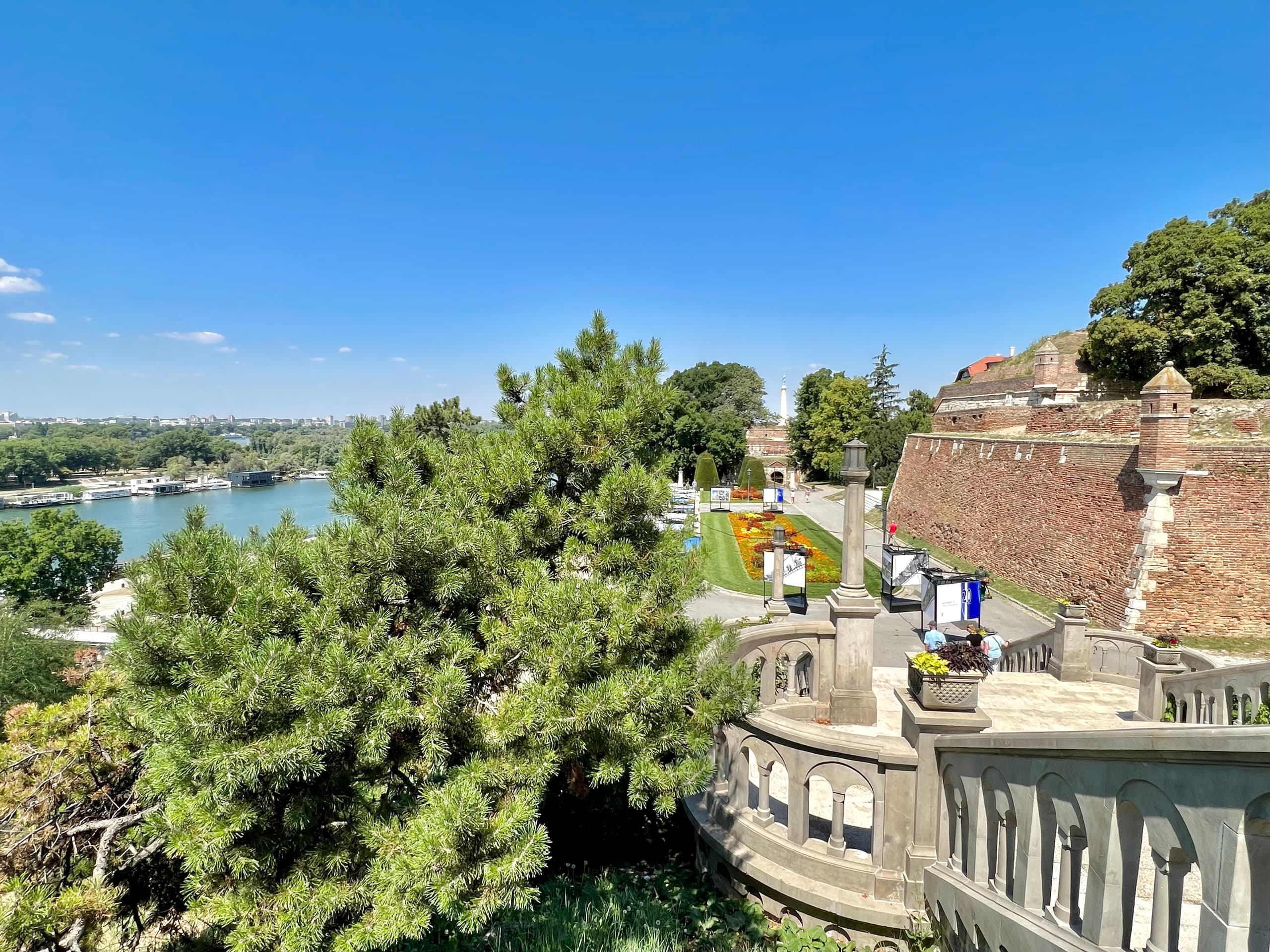
Belgrade Fortress (Beogradska tvrđava) and the Kalemegdan Park around it sit on a ridge at the exact point where the Sava river meets the Danube, and the site has been fought over for roughly two thousand years by whoever controlled that confluence.
Celts, Romans, Ottomans, Habsburgs
Celtic Scordisci tribes fortified the ridge in the 3rd century BC, naming the settlement Singidunum. Rome took over in 75 BC, and by 86 AD the Legio IV Flavia Felix had built a square castrum on what's now the Upper Town, using the position to hold the line against the Dacians across the river. Byzantine rebuilding followed in the 6th century, and by the 15th century, under Despot Stefan Lazarević, the fortress had become the seat of medieval Serbia. The Ottoman Empire took Belgrade in 1521 and held it, on and off, for close to three centuries – Kalemegdan itself is a Turkish name, from kale (fortress) and meydan (field). Most of what stands today, including the star-shaped outer defences and the baroque Clock Gate, dates to the 18th-century Habsburg occupation. Serbian control returned for good in 1867, when the Ottoman garrison handed the fortress keys to Prince Mihailo Obrenović.
The Roman Well and the Military Museum
Despite the name, the Roman Well inside the Upper Town isn't Roman at all – Austrian engineers sank the 51-metre shaft between 1717 and 1731 to guarantee water during a siege, and locals only started calling it "Roman" in the 19th century, on the belief that it sat above an older well built for the same Roman castrum. A spiral staircase still winds around the inside of the shaft. The Military Museum, founded by royal decree in 1878 and housed since 1956 in a 1924 building built for the Military-Geographical Institute, holds several thousand pieces spanning Roman armour to armoured vehicles parked on its outdoor grounds – a single collection covering nearly every army that ever fought over this ridge.
Zindan Gate and the Victor
Zindan Gate, a squat, twin-towered barbican finished between 1440 and 1456, takes its name from the Turkish word for prison – the towers were later used as dungeons. Its cannon openings mark one of the first places in the fortress built specifically for firearms rather than older siege weapons, and the defences here held against the Ottoman siege of 1456. Higher up, on the Upper Town plateau, stands Pobednik – the Victor – a 14-metre bronze nude by Ivan Meštrović, cast in 1913 and unveiled in October 1928 to mark the decennial of the Salonika Front breakthrough. He holds a falcon in one hand and a sword in the other, peace and war together; the statue was originally meant for a fountain on Terazije Square, but the nudity was judged too much for the city centre, so it ended up looking out over the rivers instead.
Visiting Kalemegdan today
Kalemegdan Park is the biggest green space in central Belgrade, and its western edge, right past the Victor monument, is where locals go for sunset, the Sava and Danube spreading out below and New Belgrade's towers on the far bank. The grounds also hold a zoo, sports courts and a rose garden, so the park functions as a working city green space as much as a monument. It pairs naturally with an afternoon at the Church of Saint Sava across town, or a full day trip north to Novi Sad and Petrovaradin Fortress, both covered elsewhere on this guide.
Good to know
Frequently asked questions
The ridge has been fortified for over two thousand years – Celtic Scordisci tribes settled it in the 3rd century BC, and the Roman legion IV Flavia Felix built a square castrum here in 86 AD – but almost everything visible today, from the star-shaped outer walls to the Clock Gate, dates to the 18th-century Habsburg occupation.
Image: Sharon Hahn Darlin via Wikimedia Commons (CC BY 2.0)