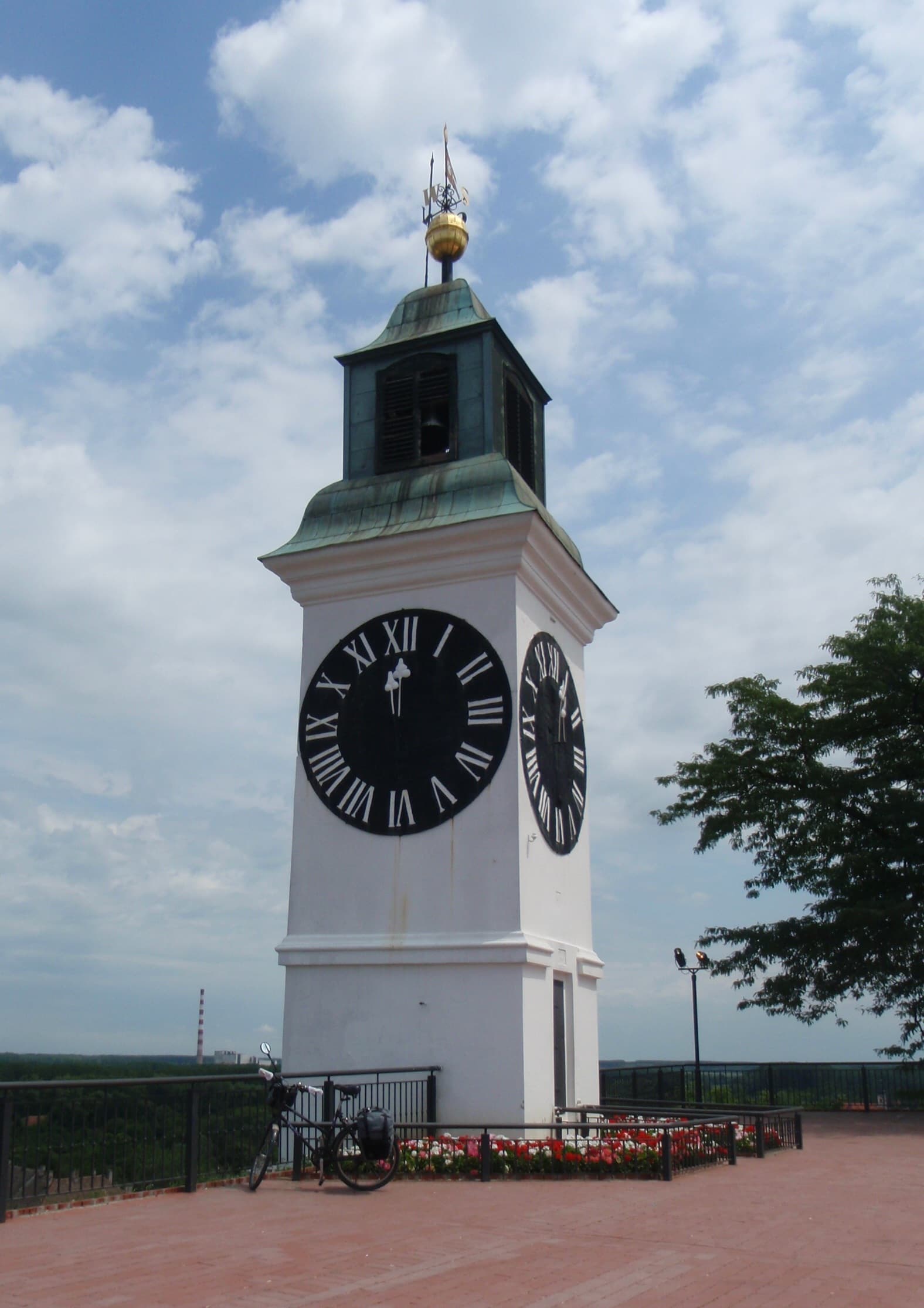
Novi Sad, Serbia's second-largest city, and Petrovaradin Fortress across the Danube from its Old Town make an easy day trip north from Belgrade – close enough for a fast train there and back, substantial enough to fill a whole day without rushing.
Getting there from Belgrade
The high-speed Soko train, launched in March 2022 on a newly built line running up to 200 km/h, covers the roughly 70 kilometres between Belgrade and Novi Sad in under 40 minutes, city centre to city centre. Older regional trains and buses still run the same route and take closer to an hour to an hour and a half, which is worth knowing if the fast service doesn't line up with your schedule – both options run several times daily, so a return trip in a single day is straightforward either way.
Novi Sad's Old Town
The centre of the action is Freedom Square (Trg Slobode), ringed by grand Habsburg-era buildings and dominated by the Name of Mary Church, a neo-Gothic Roman Catholic church built in 1894 to a design by the architect György Molnar. At 73 metres it's the tallest church in Novi Sad, its single spire visible from most of the pedestrian centre. From the square, Zmaj Jovina street runs down toward the Danube and Danube Park, a shaded strip of lawns and benches that's the natural place to end a walk through the Old Town before crossing the river toward the fortress.
Petrovaradin Fortress, the "Gibraltar on the Danube"
Petrovaradin Fortress took 88 years to build, from 1692 to 1780, as Habsburg military engineers – working in a style modelled on the French engineer Vauban and carried out under officers named Marsigli, Kaiserfeld and Wamberg – tore down an older medieval stronghold and replaced it with what became, on completion, one of the strongest fortifications in the Habsburg Empire. That reputation earned it the nickname "Gibraltar on the Danube," and beneath the visible ramparts sits a four-storey underground complex built in the 1770s, with roughly 16 kilometres of tunnels and casemates threading through the rock. The fortress was demilitarised and placed under historical protection in 1951, and it's been open for civilian use ever since.
The clock that runs backwards
The fortress's best-known feature is its Clock Tower, on the Ludwig bastion, locally nicknamed Pijani sat, the "Drunk Clock." Installed around the 1750s, its hands are reversed from a normal clock: the large hand marks the hour and the small hand marks the minutes, a deliberate choice so that sailors on the Danube below could pick out the hour from a distance without needing to squint at a shorter hand.
EXIT Festival
Since 2001, the fortress grounds have hosted EXIT Festival every July, a four-day event that grew out of a 2000 student movement for democratic change and now ranks among Europe's largest music festivals, spreading dozens of stages across the fortress's bastions and courtyards and pulling in crowds in the hundreds of thousands. Visiting during festival week means a completely different, much busier fortress than the rest of the year – worth planning around deliberately, whichever version you want.
Planning the day
Most day trips work best starting early: train or bus out in the morning, a couple of hours in the Old Town, then an afternoon crossing the pedestrian bridge to the fortress for the ramparts, the clock tower and the view back over Novi Sad and the Danube. It combines naturally as a contrast with a Belgrade-based day covering Belgrade Fortress and Kalemegdan Park or the Church of Saint Sava, both a short trip from the capital's main stations. As with Belgrade, small vendors and ticket booths in Novi Sad generally prefer Serbian dinars over cards, so it's worth carrying some cash for the day.
Good to know
Frequently asked questions
About 70 kilometres, roughly 45 minutes by the modern high-speed train and closer to an hour to an hour and a half by older regional trains or bus.
Image: Trygve W Nodeland via Wikimedia Commons (CC BY-SA 4.0)