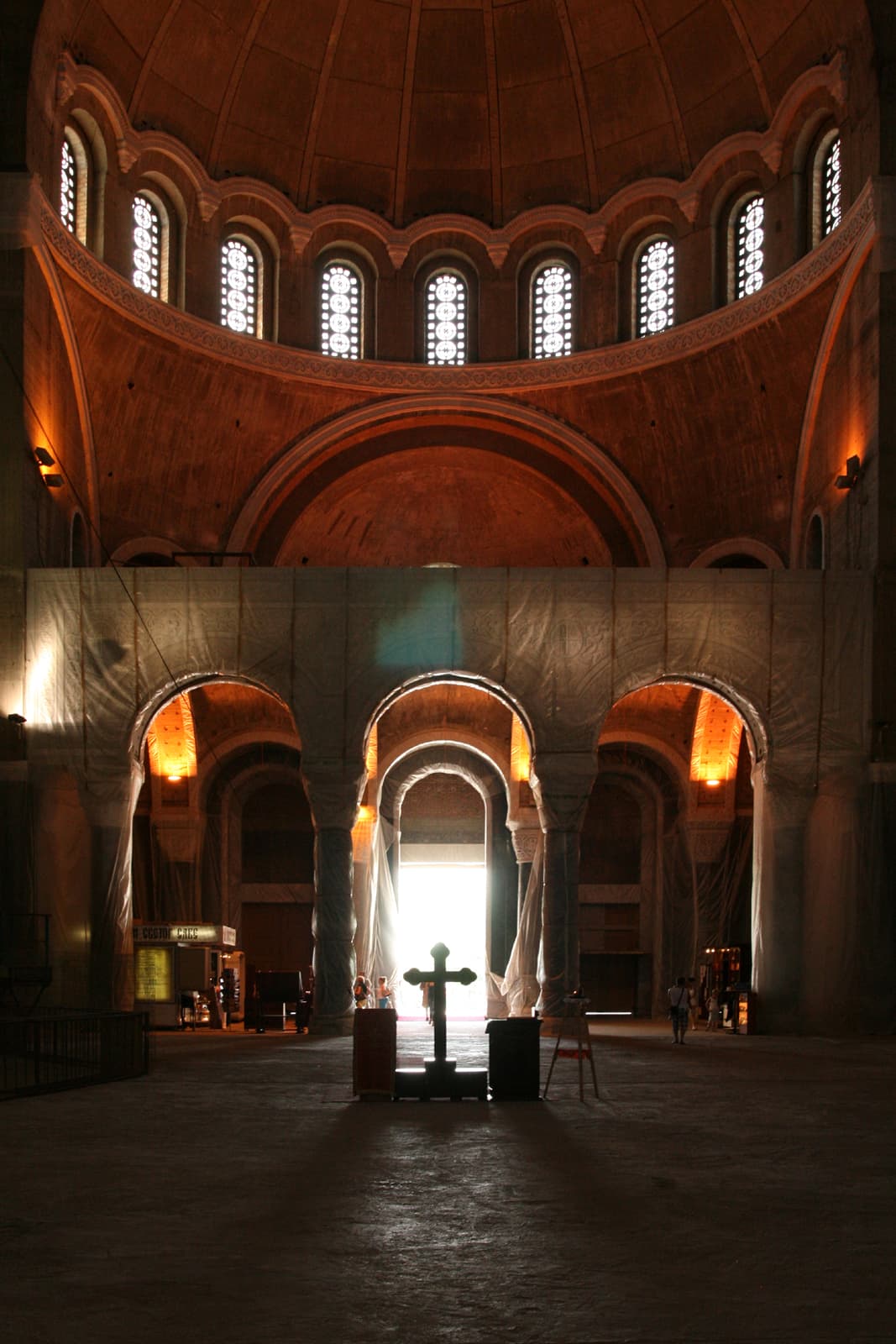
The Church of Saint Sava (Hram Svetog Save) is one of the largest Orthodox Christian church buildings in the world, standing on the Vračar plateau at the exact spot where, in 1595, Ottoman authorities burned the relics of Saint Sava, the 13th-century founder of the autocephalous Serbian Orthodox Church, in retaliation for a Serbian uprising.
A monument answering a 1595 act
The idea of marking the burning with a church dates to 1894, the 300th anniversary of the event, but building didn't start until Metropolitan Gavrilo Dožić laid the cornerstone on 10 May 1935. The design, a huge central dome over a Greek-cross plan, deliberately echoes Hagia Sophia and Serbia's own medieval monasteries rather than following a purely modern template. Within a few years the brick walls had reached 7 to 11 metres, and construction was moving at a serious pace before history intervened.
Two interruptions, one dome
The Axis invasion of Yugoslavia in 1941 halted work outright, and Communist authorities kept it stalled for decades afterward, rejecting some 88 separate requests to resume. Permission finally came through in 1984, and a liturgy on 12 May 1985 marked construction starting again. The single biggest engineering moment came on 26 June 1989, when the 4,000-tonne central dome was lifted into place – still one of the heaviest dome installations of its kind anywhere. The 1990s brought a second, longer halt, as the Yugoslav wars and the economic collapse that followed left no money for a cathedral.
Finished in 2020, eighty-five years later
The exterior, including the facade and bell towers, was finished in 2004. The interior took considerably longer: around 300 artists and craftspeople worked for roughly four years on a mosaic ensemble covering close to 15,000 square metres, built from tens of millions of individual glass and stone pieces. The Church of Saint Sava's crypt and nave were finally complete enough for Patriarch Irinej to consecrate the cathedral on 7 May 2020, eighty-five years to the week after the cornerstone went in.
The crypt and visiting today
Below the main nave, the Crypt Church of Saint Lazar the Hieromartyr functions as a separate, smaller worship space, finished and in regular use well before the mosaics upstairs were done, its walls faced in marble with their own fresco and mosaic work. Entry to the main church is free, and the interior is large enough that even a full weekend of visitors rarely feels crowded under that dome. It's an easy pairing with a morning at Belgrade Fortress and Kalemegdan Park on the other side of the city, and both sit within the wider Belgrade city guide alongside the day trip north to Novi Sad and Petrovaradin Fortress.
Good to know
Frequently asked questions
Ottoman authorities burned the relics of Saint Sava, the 13th-century founder of the Serbian Orthodox Church, on this exact spot in 1595 as retaliation after a Serbian uprising, and building a cathedral here on the Vračar plateau centuries later was a direct answer to that act.
Image: Rémi Jouan via Wikimedia Commons (CC BY-SA 3.0)